On my way to Tacomepai
This morning, after packing up my things, I ran down to a small eatery near Full Stop, the hostel I was staying at, to grab a quick meal before heading to Pai. The bus ticket to Pai cost 150 Baht plus a 25 Baht service fee (since I booked it online through Bus Online Ticket). To catch the bus, I had to make my way to the Arcade Bus Terminal in Chiang Mai.
The bus to Pai was a small one, with only ten seats, cramped and stuffy. Still, I told myself it was only a three-hour ride, so it couldn’t be that bad. But halfway through the trip, I realized just how wrong I was.
Those three hours from Chiang Mai to Pai were probably the longest three hours of my life, haunting and dreadful. I threw up everything in my stomach, my head was spinning, and I could barely sit upright. Even my trip to Ba Bể Lake wasn’t as miserable as this one. I had underestimated it, forgetting that to reach Pai, one must endure 762 curves along a road that’s barely 136 kilometers long!
When the driver stopped the bus, he turned around and gestured to tell me we’d arrived. I slung my backpack over my shoulders, clutched the seat tightly, and stepped off the bus, trying my best not to stumble. My legs felt weak and rubbery as if the slightest touch would send me collapsing to the ground.
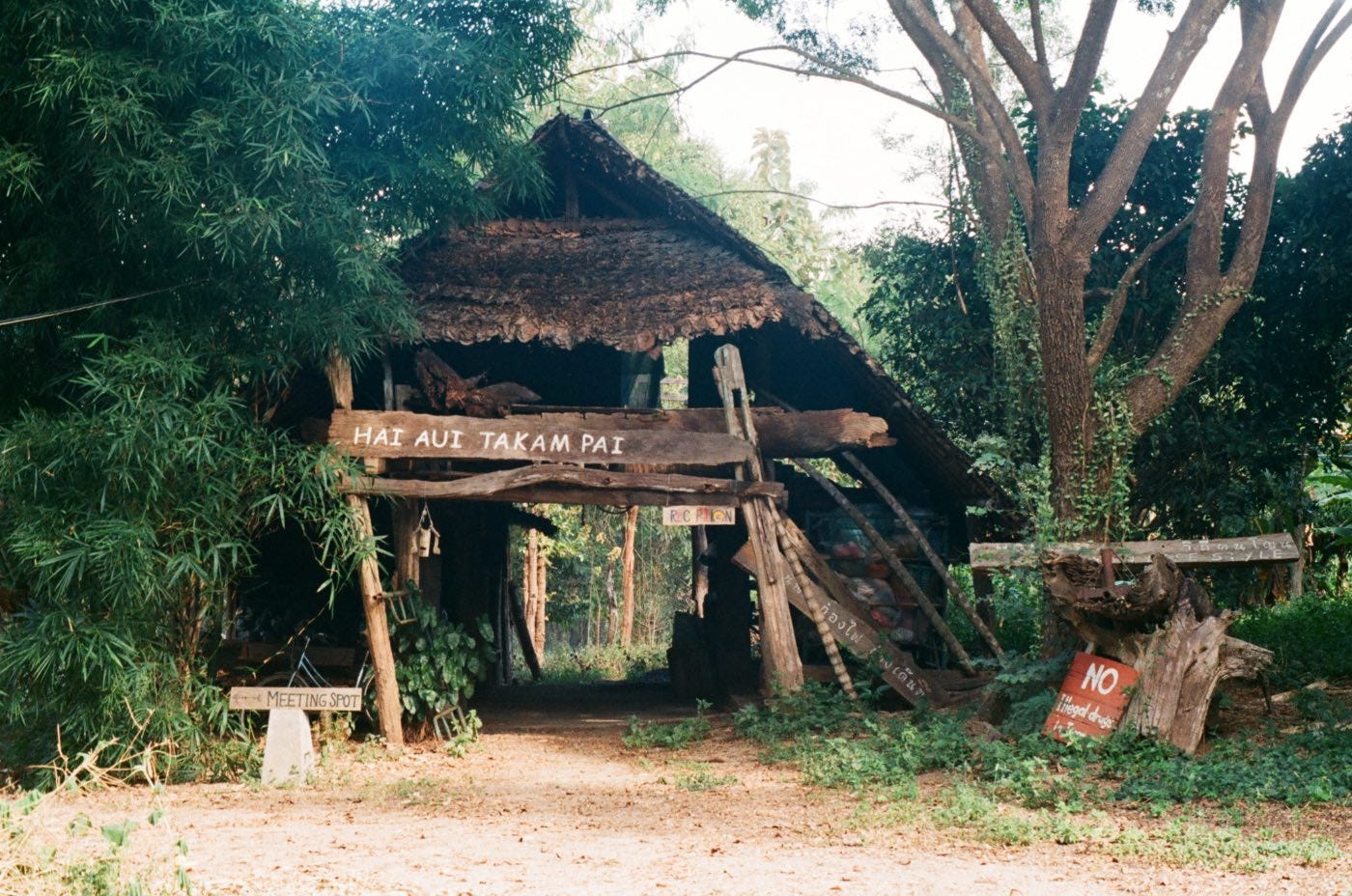
After dragging myself for what felt like forever, I finally saw the sign for Tacomepai Farm. I dropped my backpack to the ground and collapsed right there in the middle of the road, ignoring the sunlight crawling over my skin, the dust, the traffic, and the puzzled looks from people passing by. I lay there for about 10 minutes before pulling out my phone to call Pure – the owner of Tacomepai Farm.
First day at Tacomepai
Pure came to the gate to greet me and led me into the farm.
As we walked, he kept saying, “Your backpack is so small and light! Everyone who comes here usually carries these huge, bulky ones.”
I laughed and said, “Carrying too much is exhausting. I don’t like making things hard for myself.”
At that time, there were three French volunteers and one Belgian staying at the farm. They were working on a house (which, as I soon found out, was the one I’d be staying in for the next few days), humming along to the music playing from someone’s little Bluetooth speaker. I dropped my things in a corner, glanced around the house, and followed Pure to the kitchen to find something to fill my empty stomach which had been completely drained after all the motion sickness earlier.
I arrived at the farm around 3 p.m., a bit too late to do any real work, so I spent the rest of the afternoon wandering around, taking in the surroundings, and chatting with everyone. Later, I helped Pure prepare dinner and watched him cook. Everything here was so simple. The only “modern” thing in sight was a tiny fridge, worn down by time. I felt as if I had stepped back into an earlier era, when technology was still just an idea and people poured their hearts into handwritten letters sent across great distances.
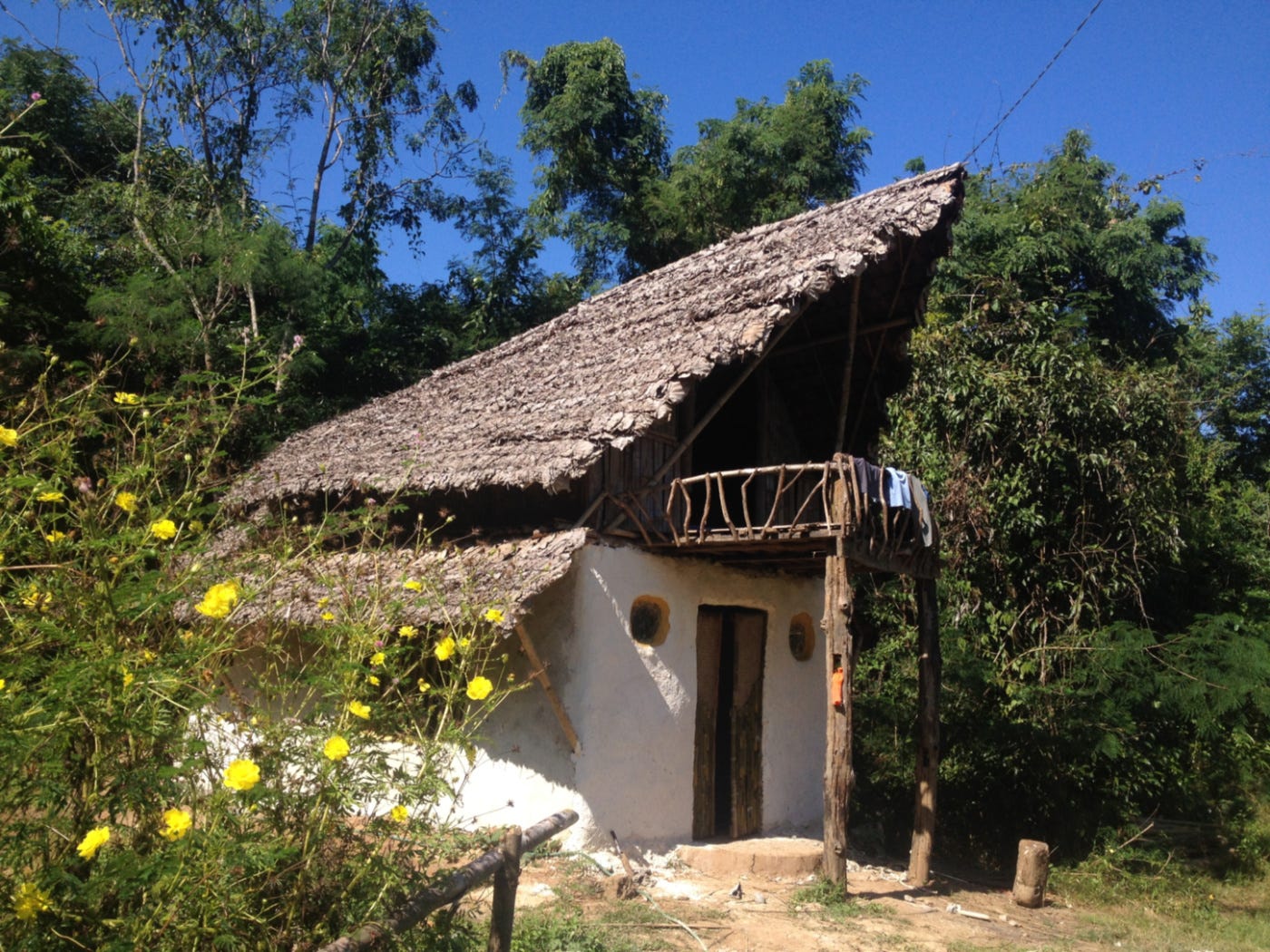
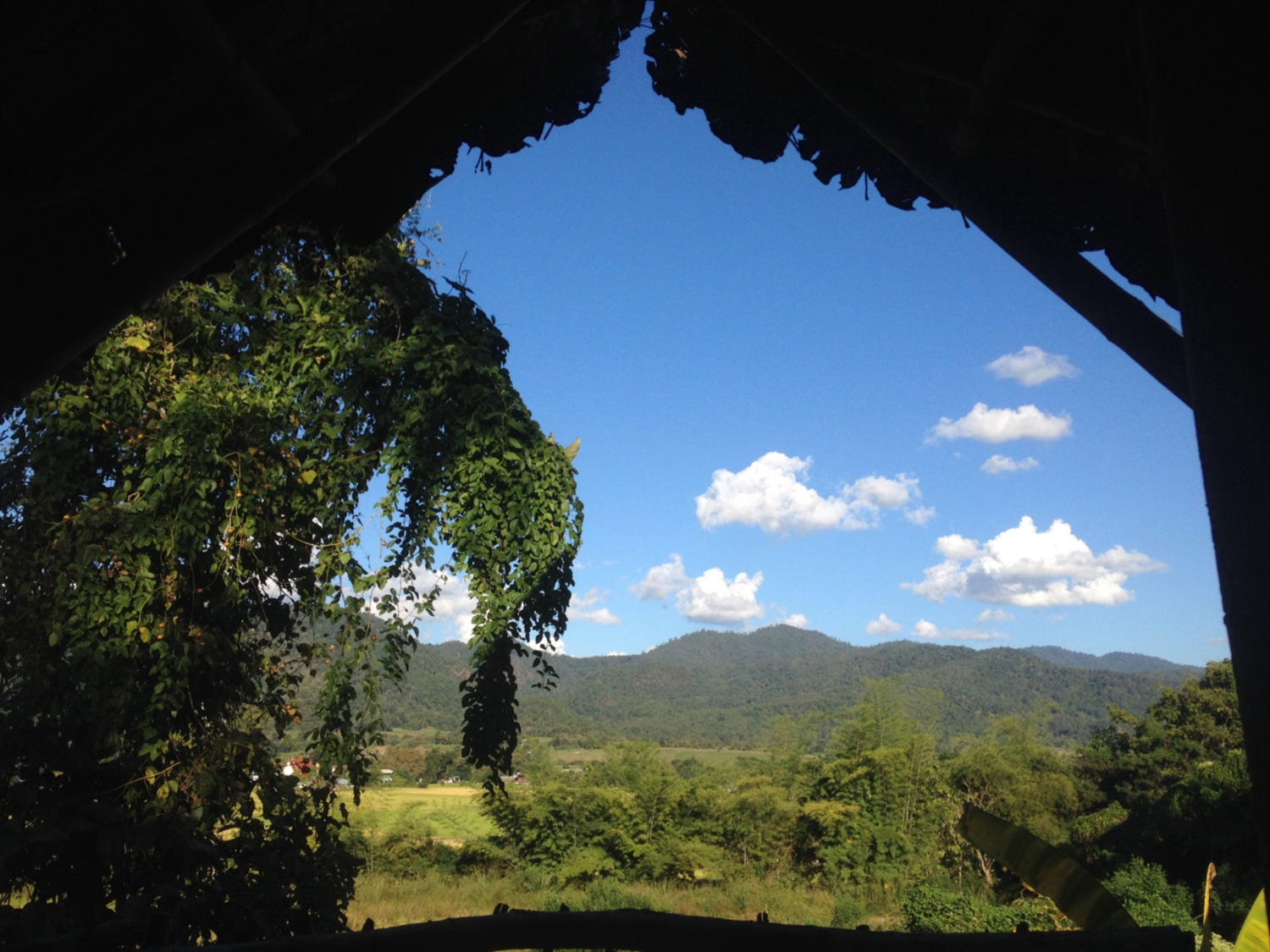
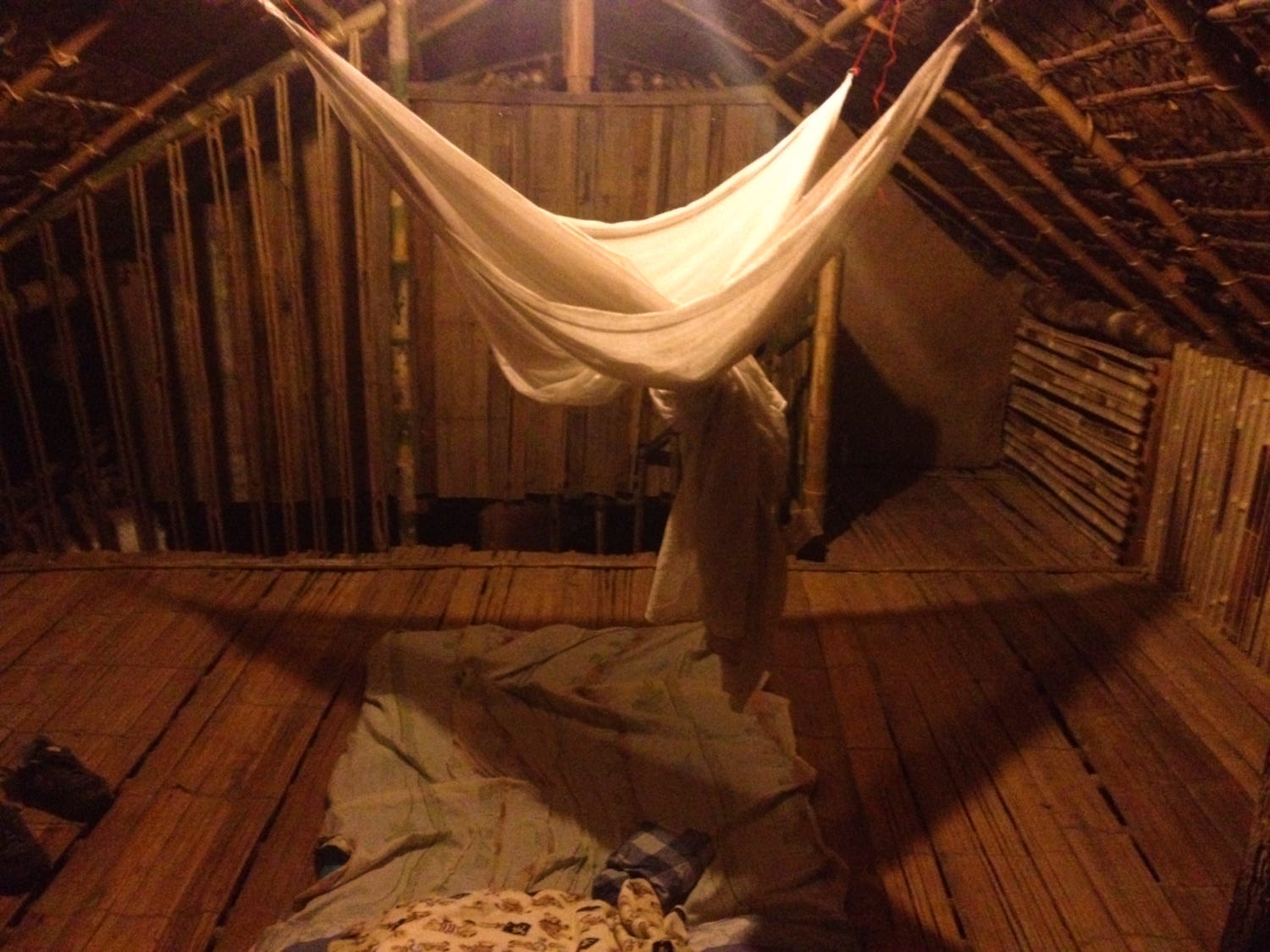
The house I stayed in was made of wood with a thatched roof and a small balcony overlooking the fields and distant mountains. Though it wasn’t fully finished yet, the thought of sleeping in a place built by so many hands from around the world filled me with a quiet sense of gratitude.
After dinner, everyone gathered to watch Pure teach us how to make soap from soap nuts. Then we played a round of Go Fish. Mosquitoes buzzed endlessly around us, and every so often someone would jump up swatting and laughing. Every now and then, Pure would grab a handful of lemongrass leaves to toss into the small fire in the middle of the room, hoping to chase away the stubborn mosquitoes.
The lights on the farm were dim – nothing like the bright glare of the city. The kitchen had just one tiny bulb, its faint yellow glow more like a nightlight than a lamp. Each of us had to hold our cards close to our faces just to see properly. Outside, the crickets breathed, frogs croaked, and the night pulsed with sound. Above us, the sky was scattered with bright, gleaming stars.
Exploring Tacomepai
I woke up just as dawn was breaking after a deep, peaceful sleep in this unfamiliar land. Perhaps that rest made up, at least in part, for the dreadful three-hour bus ride the day before. Luckily, I’ve never suffered from “can’t-sleep-in-a-new-place” or “fear of the dark.” No matter how far I travel, I can always sleep soundly. Because of that, sleeping in tents, train stations, airports, or hostels has never really bothered me.
I threw on my jacket and stepped quietly onto the balcony, tasting the crisp, clean morning air as a way to welcome the new day. The sun had yet to rise, and the leaves on the trees were still heavy with dew. In the distance, I could see Pure’s figure. He was probably checking on his rice fields.
Today, Tacomepai was saying goodbye to the three French volunteers as they continued their journey. Before parting ways, Pure decided to take all of us on a little trip around Pai. So there would be no work today.
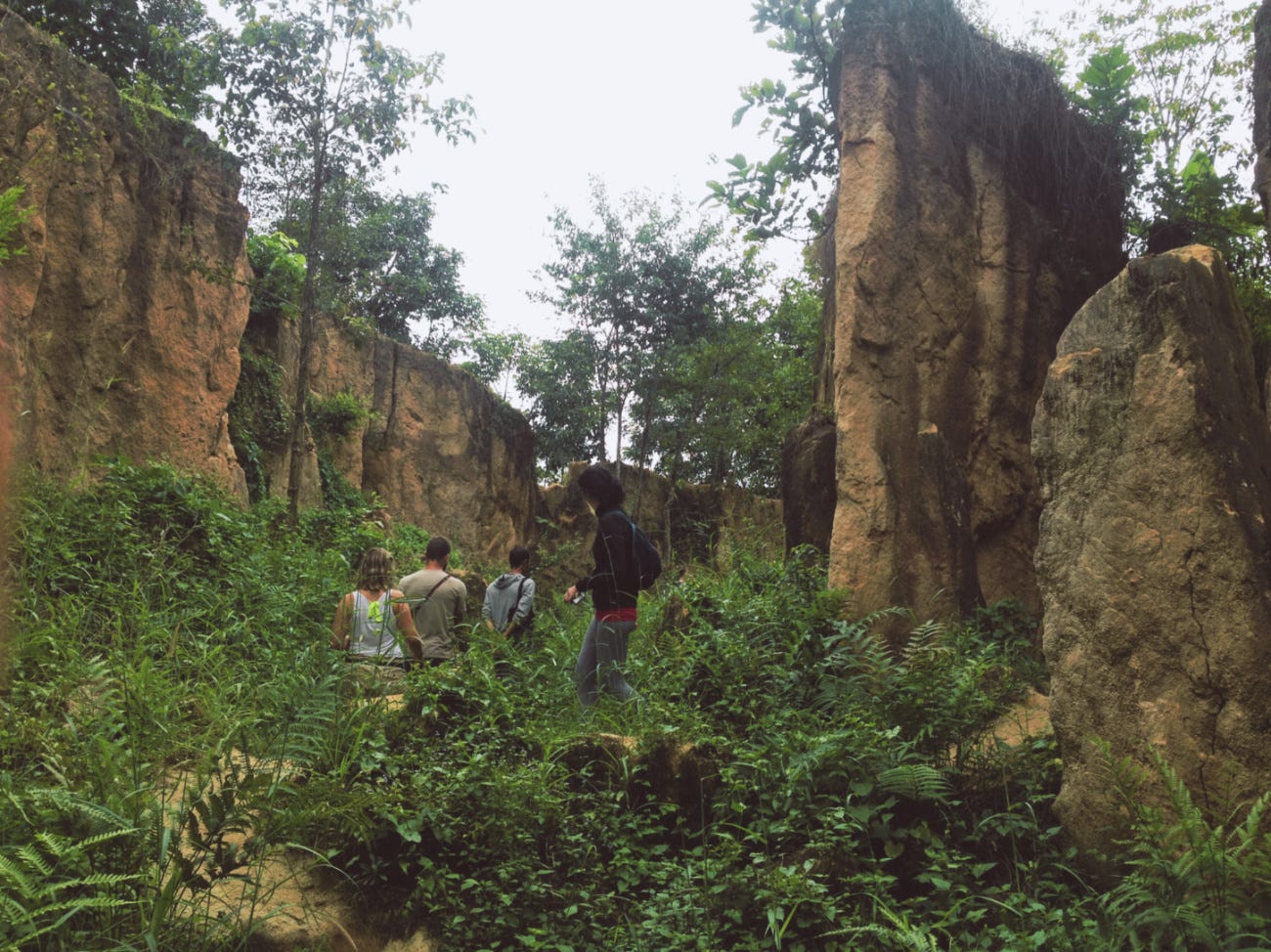
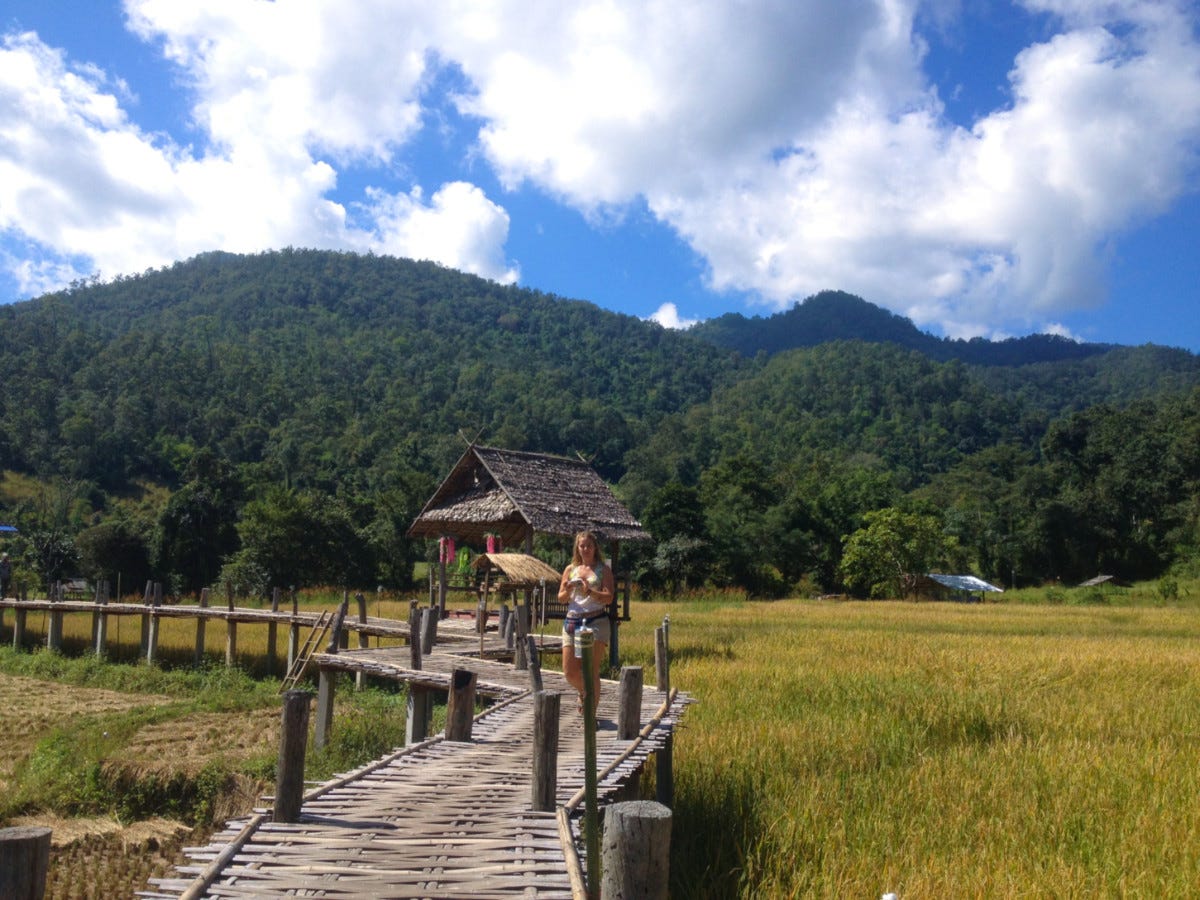
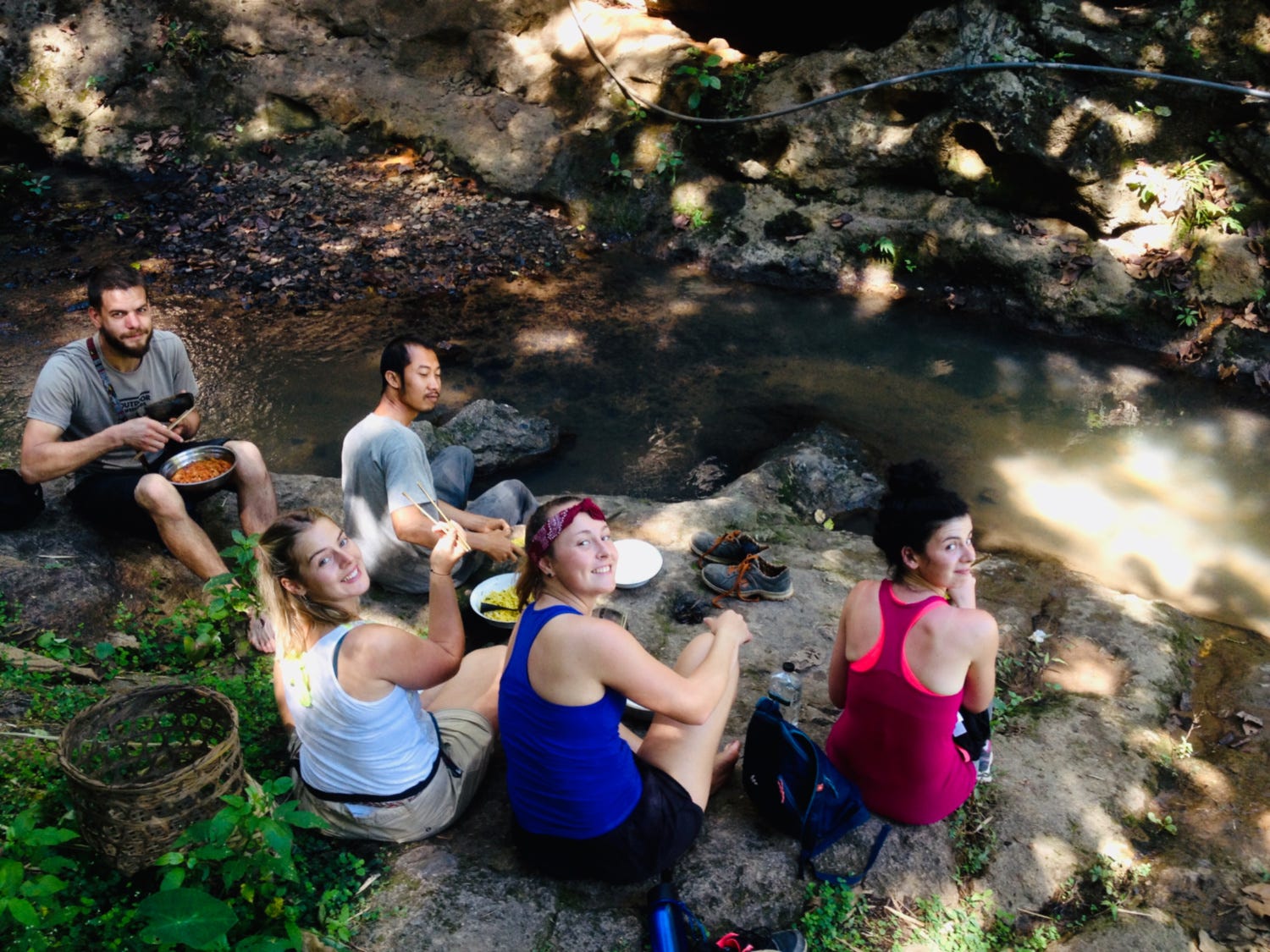
We stood in the back of Pure’s pickup truck as it sped along, the wind rushing against our faces, the sky a deep, endless blue. Pure took us to the Land Split, the Boon Kho Ku So Bamboo Bridge, and the Pai Historical Bridge. We ended the day with lunch at the foot of Pam Bok Waterfall.
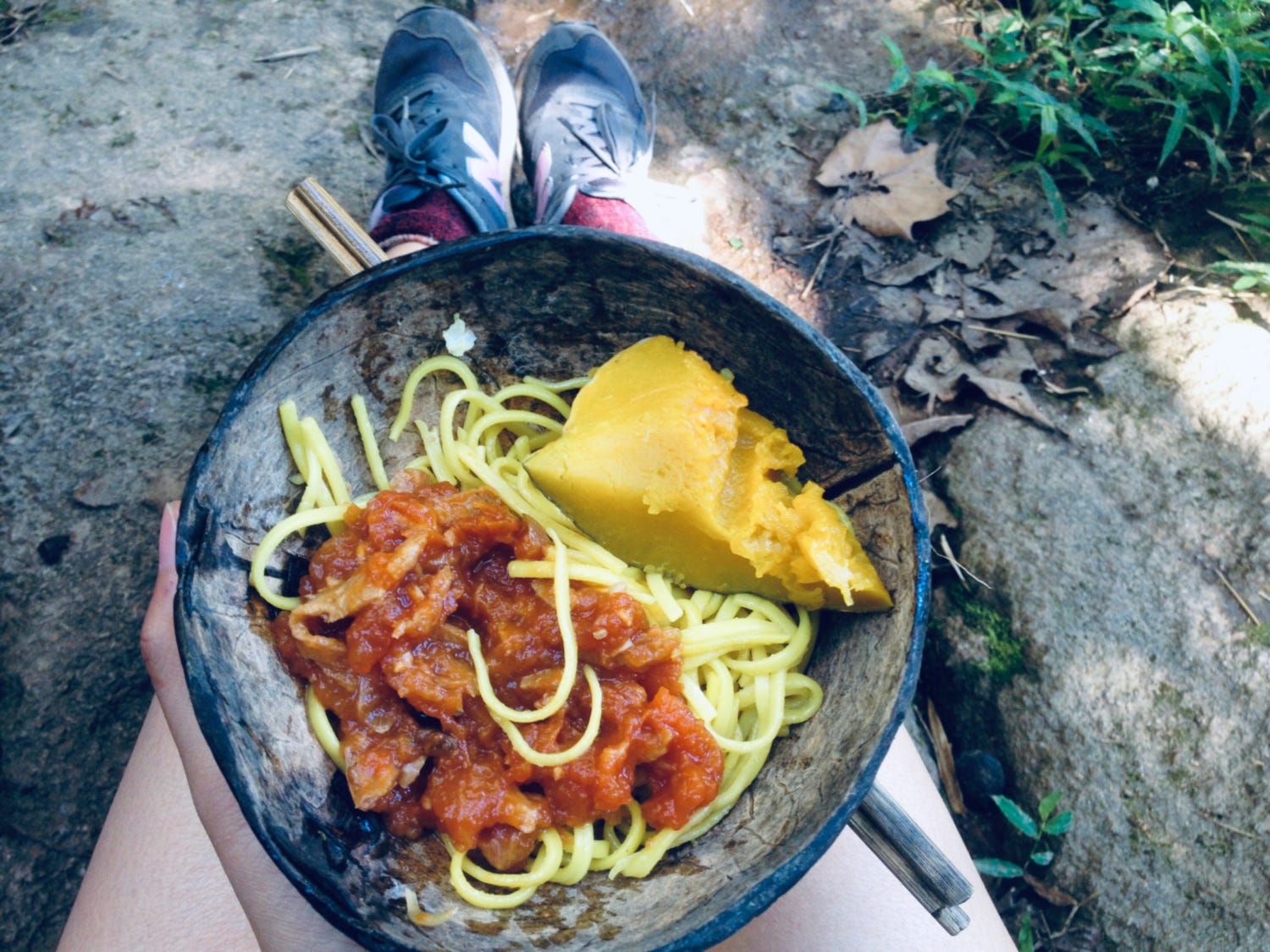
The work at Tacomepai wasn’t as busy as I had imagined. When I arrived, it wasn’t yet harvest season. Pure told me that things wouldn’t get hectic until next month, when the rice ripens. That’s when everyone would be harvesting, drying, and packing the grains for storage. For now, our days were mostly spent sowing seeds and planting a few more crops.
The next morning, a few of us followed Pure around as he showed us every corner of Tacomepai. He explained the daily tasks of the volunteers, pointed out the projects that had already been completed, and shared plans for future ones. There seemed to be hundreds, maybe thousands, of different plants here and it felt as though every single one growing on this land served some useful purpose.
In the following days, we planted lemongrass in the empty patch near the kitchen, added some roselle, and sowed coriander seeds in the newly prepared beds. When we got tired of gardening, we turned our attention to fixing up the “bathroom” of my house which was still under construction, with the toilet and shower area half-finished and cluttered. The sound of music, chatter, and footsteps blended into a steady, familiar rhythm that made the whole place feel alive.
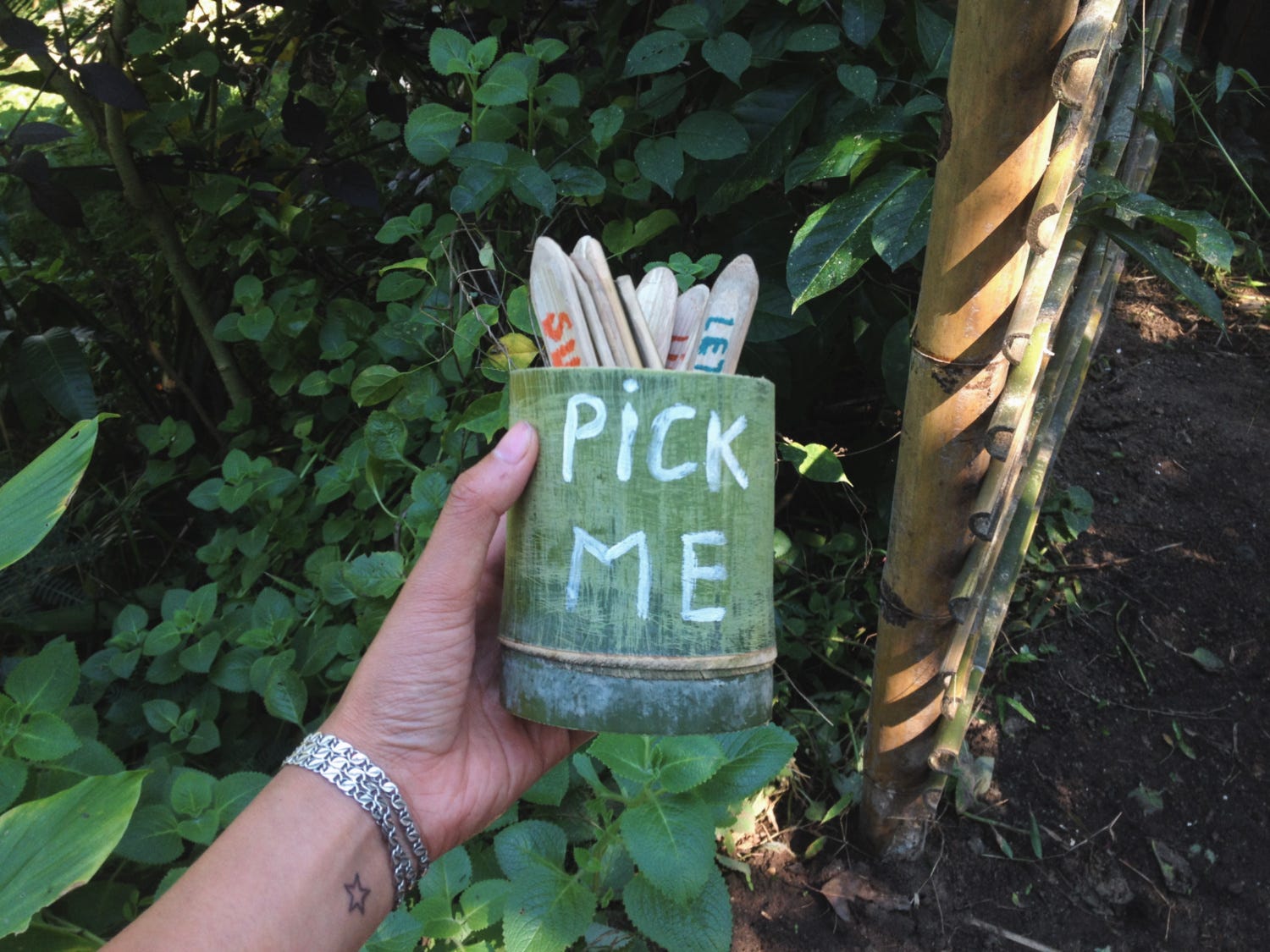
That morning was cool and gentle, with a touch of breeze and clouds. While waiting for everyone to wake up for breakfast, I sat outside, finishing the bamboo spoon I had started carving the night before. Perhaps because I seemed so engrossed in it, Pure laughed and said he’d go chop down more bamboo so I could spend the whole day carving spoons and chopsticks.
And so, that day, instead of digging soil or planting seeds, I spent the entire day working with the fresh bamboo Pure had cut. He showed me how to split and shape it with a knife. One of his upcoming plans, he told me, was to turn the house I was staying in into a small workshop for making bamboo crafts.
Tea and stories…
Pure slowly sipped his tea from a bamboo cup, its surface smooth and polished after being dried over smoke. His eyes drifted into the distance toward a space untouched by the faint yellow light of the lamp.
That night, everyone else went out to unwind after a long day of working under the sun and in the mud, leaving just the two of us at home – two souls preferring quiet over noise. I pulled out a small bundle of dried stevia and mint I’d brought from Da Lat, dropped a handful into the kettle of gently boiling water, while Pure sat there, lost in his memories.
He told me about the changes he’d gone through, and what had led him to abandon everything to return to nature – to the earth and the sky. Pure said he felt complete with what he had and wanted nothing more. He loved this place deeply and had no desire to leave. Here, he had found himself. Here, he could simply be.
Time passes, and eventually, each of us learns to choose our own path, our own way of living as long as we keep believing that somewhere out there, a road still waits for us. Pure had found his: the road back to nature, back to Mother Earth.
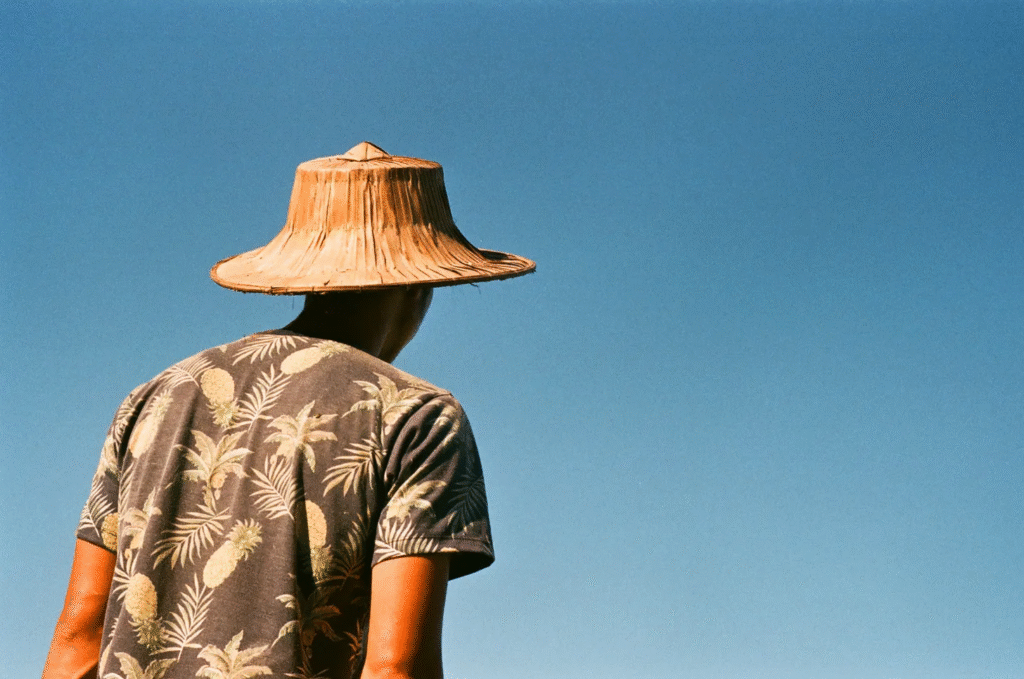
The Pure of the past was shattered, lonely, lost – standing close to death. The Pure of today is a free and peaceful farmer, spending his days in the company of rice fields and bamboo groves
(Tacomepai, Thailand, 2018.11)

Leave a Reply